
Founder Education Series
How SAFE Financing Works
Every dollar you raise changes what you own, who controls your company, and who gets paid first at exit. This guide walks you through the full picture — from your first SAFE to Series B — so you understand every tradeoff before you sign.
Visual Reference
The full Picture
Everything on one chart — equity structure, board control, liquidation preference, and how SAFEs convert. Reference this at every stage of your fundraise.
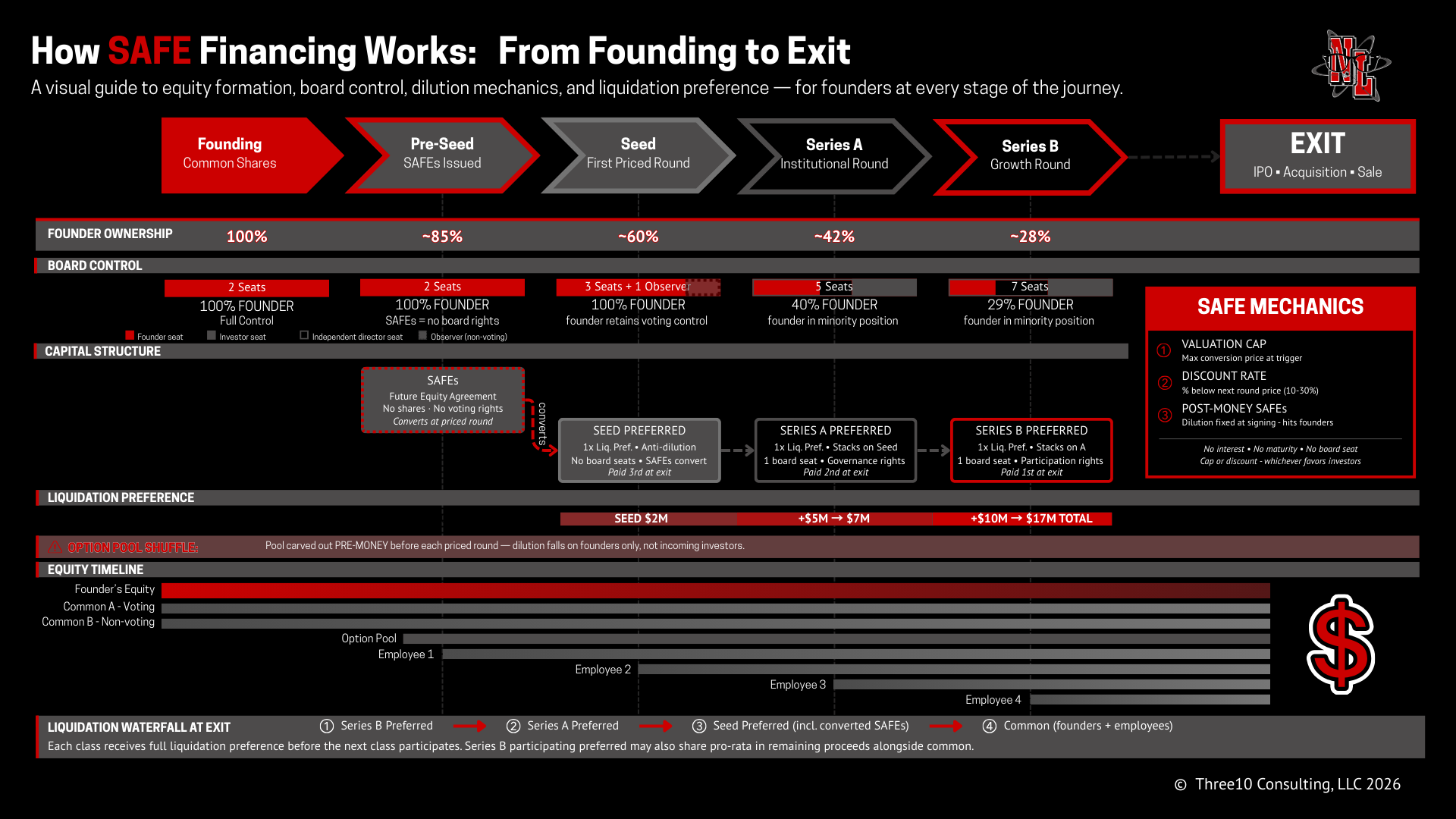
the instrument
What is a SAFE?
A SAFE — Simple Agreement for Future Equity — is a contract that lets an investor put money into your startup today in exchange for the right to receive shares later, when you raise a priced round. It was created by Y Combinator in 2013 as a faster, cheaper alternative to convertible notes.
When you issue a SAFE, the investor doesn't get shares immediately. They get a promise: when your company raises its first priced round (typically Seed or Series A), their investment converts into preferred shares at a discount or capped price. Until then, they hold no equity, have no voting rights, and sit on no board.
The key insight: SAFEs feel simple on the way in. But every SAFE you issue is a future dilution event waiting to happen — and the timing, size, and terms of that dilution are often poorly understood by founders until it's too late to negotiate.
Valuation Cap
The maximum company valuation at which your SAFE will convert. If your cap is $5M and you raise a Seed at a $10M valuation, SAFE holders convert as if the company were worth $5M — getting twice as many shares as new investors at the same price.
Discount Rate
A percentage reduction off the next round's price per share — typically 10–30%. A 20% discount means the SAFE holder pays $0.80 for every $1.00 share the new investors pay. The investor uses whichever term — cap or discount — gives them more shares.
Post-Money SAFEs
The current YC standard. The SAFE holder's ownership percentage is calculated after the SAFE is issued — meaning dilution is fixed at the time you take the money, not at conversion. This is predictable for investors and often overlooked by founders who don't model it out.
Conversion Trigger
SAFEs convert automatically at the first "equity financing" above a minimum threshold — usually $1M. Until that trigger fires, SAFE holders hold no shares, attend no board meetings, and receive no financial statements unless you voluntarily share them.
the stack
Preferred Shares: Not all Equal
Each priced round creates a new class of preferred stock with its own rights. They stack in reverse order at exit — the last investor in gets paid first.
 • Paid 3rd at exit
 • Weakest Rights
Seed
Preferred
Liq. Preference
Anti-Dilution
Board Seat
Protective Provisions
Dividends
Pro-Rata Rights
Info Rights
1x Non-Participating
BBWA Standard
Rarely — Observer only
Narrow (3–5 items)
Often none
Major investors only
Basic annual financials
3rd in Waterfall
  • Paid 2nd at exit
  • Standard Rights
Series A
Preferred
Liq. Preference
Anti-Dilution
Board Seat
Protective Provisions
Dividends
Pro-Rata Rights
Info Rights
1x — sometimes participating
BBWA - may push harder
1 Designated Seat
Standard NVCA (8–12)
6–8% cumulative, rarely paid
Standard — all investors
Full NVCA: monthly + audited
2nd in Waterfall
  • Paid 1st at exit
  • Strong Rights
Series B
Preferred
Liq. Preference
Anti-Dilution
Board Seat
Protective Provisions
Dividends
Pro-Rata Rights
Info Rights
1-2x — Participating Preferred
May push for full ratchet
1 Additional Seat
Expanded + Layered veto
6–8% cumulative, rarely paid
Often super pro-rata
Full NVCA + tighter SLAs
1st in Waterfall
Governance
How you Lose Control
Board composition evolves at every priced round. Founders start with 100% of seats. By Series B, they're a minority — even if they still own the most equity.
Founding
2 seats · 100% founder
Pre-Seed
2 seats · SAFEs = no board seats
Seed
3 seats · Observer added, no vote
Series A
5 seats · Founders: 40%
Series A
7 seats · Founders: 28%
Founder Seat
Investor Seat
Independent Director
⚠ The Series A Inflection Point
Series A is where control structurally shifts. The standard 5-seat board (2 founders / 1 investor / 2 independents) means founders need the two independent directors on their side to pass any vote. Choose independent directors carefully — they're not neutral parties, they're swing votes on every significant company decision.
exit economics
The Liquidation Waterfall
At exit, proceeds don't flow to all shareholders equally. Preferred shareholders collect their full preference first — in reverse order of investment. Common shareholders (founders, employees) receive what's left.
PRIORITY
CLASS
GETS PAID
CONDITION
First
Series B Preferred
1–2x invested capital + participating upside
Before anyone else receives proceeds
EXAMPLE: Three Exit Scenarios
Assume: $2M Seed · $10M Series A · $25M Series B. Total preference stack = $37M. Founders + employees own 28% of common.
Below the stack$20M Exit
Series B
Series A
Seed
Common
$20M
0
0
0
Series B doesn't even recover full preference. All
other classes receive nothing.
Second
Series A Preferred
1x invested capital
After Series B is fully paid
Third
Seed Preferred
1x invested capital
After Series A is fully paid
Third
Common Shares
Everything remaining
Only after all preferred preferences satisfied
At the stack$40M Exit
Series B
Series A
Seed
Common
$25M
$10M
$2M
~$840K
Preferred fully paid. Founders share the $3M
remainder. A $40M exit barely moves the needle.
Above the stack$150M Exit
Series B
Series A
Seed
Common
$20M
$10M
$2M
~$32M
All preferences satisfied with room to spare.
Founders receive 28% of $113M remainder.
Hidden dilution
The option Pool Shuffle
Investors will ask you to create or expand an option pool before closing a priced round. Where that pool comes from is one of the most important — and least understood — points in term sheet negotiations.
Pre-Money Pool (What Investors Want)
The option pool is carved out of the pre-money valuation. It comes entirely out of the founders' shares. New investors' ownership percentage is calculated after the pool is set aside — so they never pay for it. You take 100% of the dilution.
Post-Money Pool (What Investors Want)
The option pool is created from the new shares issued in the round. Dilution is shared proportionally across all shareholders — founders and investors alike. This is harder to get but worth fighting for, especially on larger pool sizes.
Practical example: Investors ask for a 15% option pool at a $10M pre-money valuation. If it's carved pre-money, founders effectively accepted a $8.5M valuation for their shares — not $10M. On a $1M investment, that's a meaningful difference in actual dilution.
ready to Get This Right
From Day One?
Nerd Lawyer works with founders to build investor-ready legal infrastructure — from your first SAFE to your Series B. Clean caps, clean docs, no surprises at diligence.